USEFUL GENERAL INFORMATION CONCERNING THAILAND
APSARA TOURS PROVIDES YOU WITH INFORMATION THAT YOU SHOULD KNOW

General Information
- Official Name: Kingdom of Thailand
- Government: Unitary parliamentary democracy and constitutional monarchy
- King: Vajiralongkorn (Rama X)
- Prime Minister: Mr. Prayut Chan-o-cha
- Population: 66,720,153 in 2011
- Area: 513,120 km2
- Capital City: Bangkok, population 9.3 million
- People: Thais (75%), Chinese (14%), Indians (11%)
- Religion : Buddhism 94.6%
- Language: Thai
- Currency: Baht (THB)
- Time Zone: GMT +7 Hours
- International Dialing Code: +66
- Drives on the: Left
Pre Departure Check List
- Travel Insurance
- Valid Passport (at least six months remaining)
- Immunizations/Vaccinations
- Foreign currency (see header “MONEY” below)
- Flights tickets
- Photocopy of passport
Travel Insurance
Apsara Tours will do everything possible to ensure a safe and unforgettable journey. However, certain risks are involved and should be recognized by the travelers. That is why we encourage all guests to purchase travel insurance prior to their trip. Travel insurance is a cost effective way of protecting yourself and your equipment in the event of problems due to cancelled trips, delays, medical emergencies, baggage loss or damage.
Visa & Passport
A passport with at least six months validity is necessary. Visitors from most countries who arrive in Thailand without a visa will be granted a 30 day stay if they have proof of an onward ticket and adequate funds. For longer stays a visa should be applied for before departure. A tourist visa allows you to stay for 60 days. This visa is extendable 30 more days through representations to the immigration authorities of the province you are visiting. You need to enter Thailand within 90 days of the visa being issued otherwise it will be invalid. Some countries have special agreements with Thailand regarding the issue of visas.
Health Information
Health care in Thailand is generally some of the best in South-East Asia, hospitals are generally at a Western level of service. However please take note that the health care can be expensive. Each traveler is responsible for his or her health. First and foremost make sure that you have travel insurance for your trip. Also, consult your doctor or local travel clinic before departure (ideally two months before your holiday) for the latest information on travelling to Thailand.Before travelling to Thailand. Before travelling to Thailand, it is important to ensure that you have adequate protection about disease and whether you need vaccinations before you travel. These will vary depending on where you are planning on visiting. Bear in mind that there is a malaria risk in rural parts of Thailand. In general, most visitors to Thailand will require the following vaccinations:
Hepatitis A and B
Tetanus
Typhoid
Polio
Diphtheria
If you have any special conditions or allergies that may require attention overseas, have your GP write a letter describing the nature of the condition and the treatment. Always carry the letter on your person. It is also a good idea to bring your own basic medicine kit with you containing some basics like paracetamol and diarrhea relief.
Money
The official currency of Thailand is the Thai BAHT (pronounced – baaht).
One baht is divided into 100 satangs.
Coins come in denominations of: 1, 2, 5 and 10 baht, as well as (rarely seen or used) in 1, 5, 10, 25 and 50 satang.
Paper Notes come in denominations of: 20, 50, 100, 500 and 1,000 baht.
The most commonly used coin is the 10 baht and the most commonly used note is the 100 baht.
ATM: Money can be withdrawn from ATM using a non-Thai credit card.Most Thai banks are now charging a THB180 fee per withdrawal when you use their ATM. Your home bank may also levy a fee or fees. Using ATMs is a safer option than cash and more convenient than T/Cs. This may be an excellent option if your home bank does not charge high fees. ATMs are plentiful and located just about everywhere.
FOREX (FOreign EXchange): booths are very common and clearly post their daily exchange rates on an electronic notice board.
Cash exchanges in Thailand incur NO commissions or fees.
Do not buy any Thai currency until you arrive in Thailand.
The rates offered in Thailand are ALWAYS BETTER than you could get back home.
FOREX booths accept ALL MAJOR currencies.
DO remember to bring ONLY bank notes in good overall condition.
FOREX booths generally WILL NOT accept bank notes that are torn, ripped, damaged or are excessively marked/stamped.
Credit cards are accepted in large centers/hotels
Tipping is a personal matter and is your own personal way showing you appreciations towards the people serving you. We encourage passengers to tip an amount they find appropriate. For your convenience our staff will provide you with the proper information on arrival.

Clothing & Suggesting Packing List
- Personal clothing items, toiletries, medication
- Sunscreen
- Insect Repellent
- Light weight clothing (Summer months)
- Long sleeved shirts and pants (for visiting Temples and Wats)
- Light jacket when visiting the North in the evenings
- Camera
- Adaptor – 220V, 50Hz; 2 pin plugs (Thai standard pin plugs are the American flat pin plugs but generally accept without adaptor the European round pin plugs
Climate
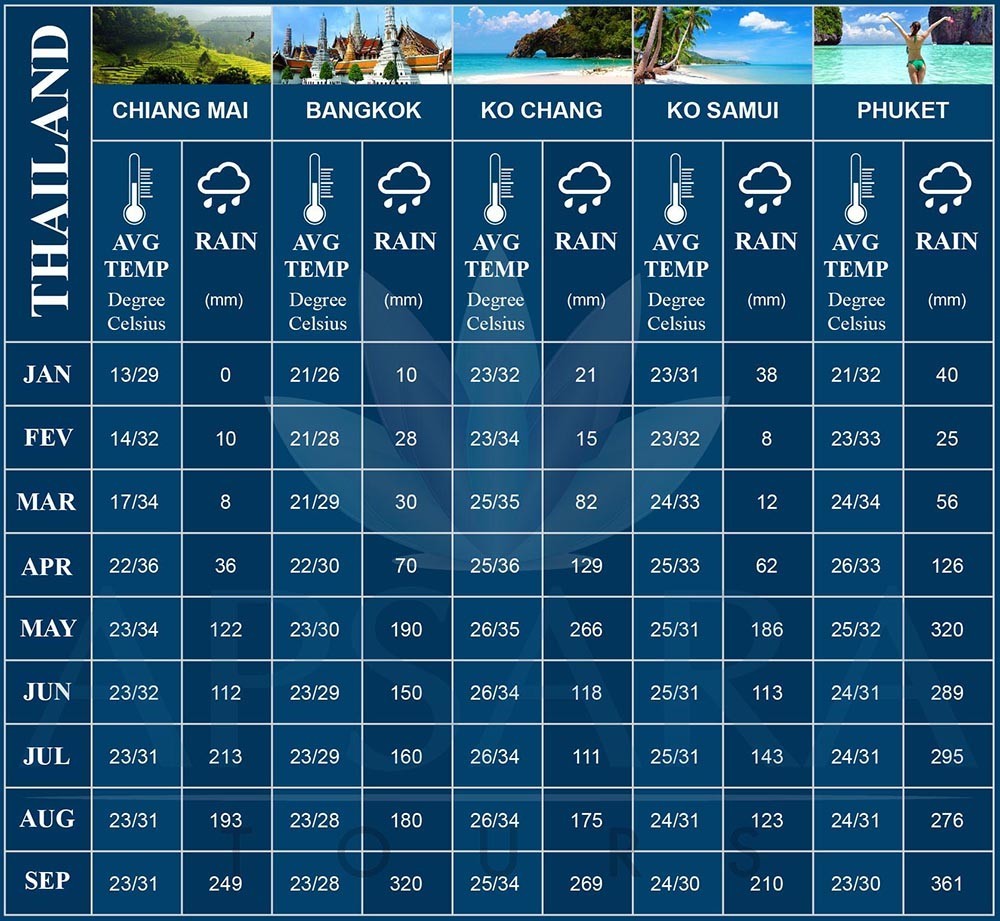
Thailand’s climate is tropical, high both in temperature and humidity, and dominated by monsoons. April and May are the hottest months of the year, when even the locals are moved to complain about the heat. June sees the beginning of the South West Monsoon, and brings with it the rainy season, which continues intermittently until the end of October.
From November to the end of February the climate is much less trying with a cooling North East breeze and a reduction in the humidity level. This is also the main tourist season, and the best time to visit Thailand.
The north and north-east are generally cooler than Bangkok in winter, and hotter in summer. In the far north, around Mae Hong Son temperatures can occasionally drop as low as 2oC.
June – October: Rainy season (Southwest Monsoon)
November – February: Cooler with reduced humidity
April – May: Hottest months
APSARA TOURS CO., LTD.
272 Soi Pattanakarn 50
Pattanakarn Road, Suan Luang,
Suan Luang Bangkok 10250
Thailand
+66 (0) 2321-9694
+66 (0) 2321-9694
INFO@apsaratours.co.th
ORDER@apsaratours.co.th

Offer more than tours.
Go beyond the ordinary.
Consider guests as extraordinary!
THAILAND PARTNERS


































Co., Ltd. License No: 0105545020143
TAT License No: 14/00041
ATTA Member Code: 02154